
Some Comments on the Art of Pierre Soulages
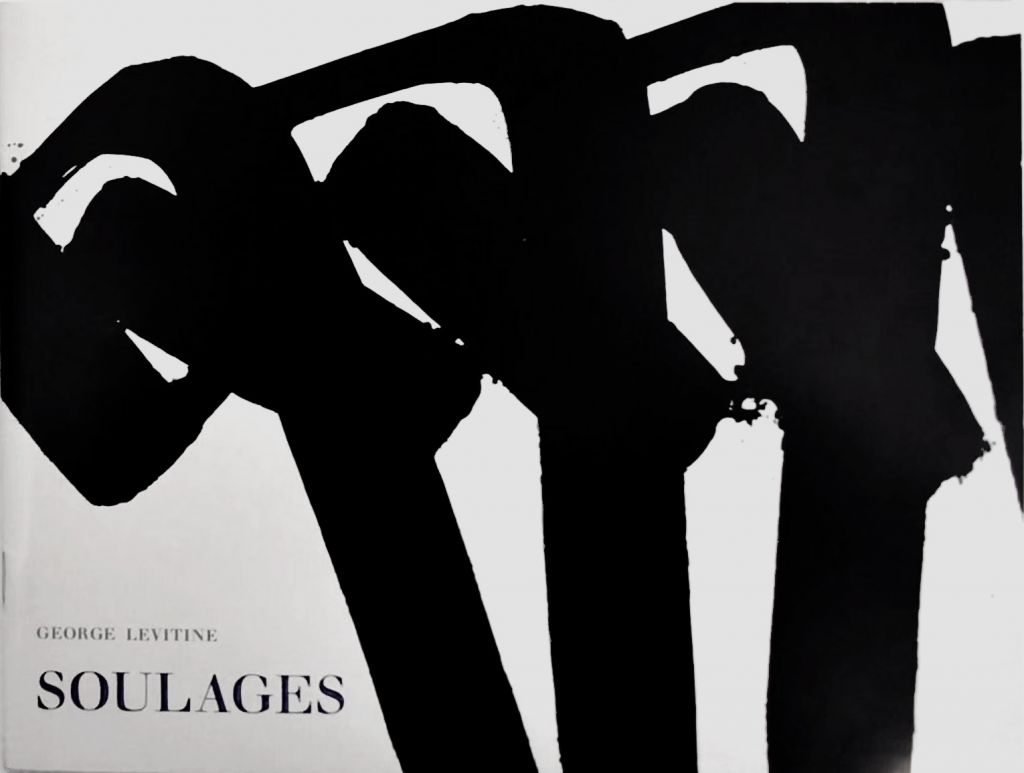
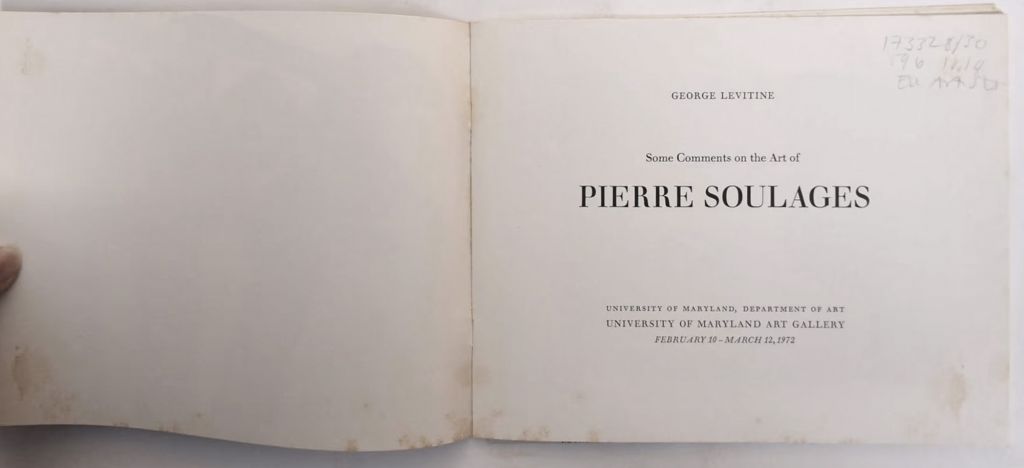
Le catalogue d’exposition Some Comments on the Art of Pierre Soulages, rédigé par George Levitine en 1972, est un livret d’analyse critique très ciblé et rare de 12 pages (accompagné de 4 pages d’illustrations).
Préface :
The generosity of the following lenders has made this exhibition possible: Alcoa Collection of Contemporary Art, Pittsburgh; Mr. Robert Eichholz, Washington; M. Knoedler & Co., Inc., New York;
The Phillips Collection, Washington; Museum of Art, Carnegie Institute, Pittsburgh; and The Museum of Modern Art, New York. I am deeply grateful to them, not only for their support of this exhibition, but of earlier exhibitions held in the Gallery to which, with like generosity, most of them have also lent works from their collections. Both Mr. Soulages and Mr. Xavier Fourcade of M. Knoedler & Co., Inc., New York, his American representative, have taken an active interest in the exhibition; my deeply telt gratitude extends to them. I wish also to thank Dr. George Levitine.
Head of the Department of Art of the University, in general, for his full support of the program of the Gallery, and, in particular, for his perceptive comments on the art of Soulages, written for this catalogue
Marchal E. Landerer
Director, Art Gallery
SOME COMMENTS ON THE ART OF PIERRE SOULAGES:
A Painter from the Rouergue in Paris
Few critics seem to have resisted the lure of the Muse when called upon to write about Pierre Soulages. Descriptions of his art summon the image of canvases weighed down with copious layers of poetic metaphors, symbols, and similes. Writers evoke the richly textured forms of the Romanesque churches and of the prehistoric megaliths found in the painter’s native Rouergue province. They also speak of bare black trees, stained-glass windows, scaffoldings, Gregorian chant, stormy clouds, grottoes with floating lights, underwater glimmers, limestone chasms, and dams about to burst. The list could be extended almost indefinitely: one is reminded of the polyphonic expressiveness of some Baroque mystic writings.
These inventive verbalizations, of course, are not always persuasive: one soon reaches the limits of their relevance to Soulages’s art, and the most persistent of them, the idea of black trees, was specifically rejected by the painter himself. Thus, speaking of these trees (one thinks of Chateaubriand’s belief that the concept of the Gothic vault originated in a forest!) Soulages states that a similar « point of departure » for his abstractions could have been provided by the bars of a window or the back of a chair. On the other hand, one should not forget that the artist also does not hesitate to speak of his need for « poetic intensity and that he tells of his decision to become a painter whe visiting the Romanesque church of Sainte-Foix, at Conques. It can be seen that the realization oi the shortcomings of « poetic criticism » should be accompanied by the acceptance of its inevitability Soulages’s works do not easily lend themselves to an objective critical approach.
Despite its heterogeneity, the kaleidoscopic imagery woven around soulages’s art tends to give relief to the same few recognizable qualities. First of all, his abstractions are evolved independently from any preconceived context. His painting starts from a brush-stroke rather than from a visual
[…]
is applied on a subtly modulated, colored (no longer white) background (fig. 2). This period coincides with the appearance of a more painterly quality, achieved through the use of the palette-knife, with transparencies and occasional impasto. During the 196os, the style changes again. Soulages’s painting is dominated by massive, blot-like silhouettes, built by a succession of overlapping strips of identical, or slightly different values and colors. They flow or trickle into one another, leaving unexpected openings — colored or white holes — which, by contrast, acquire a particularly vulnerable coloristic exquisiteness (figs. 3-8). It is foolhardy to predict the future development of a great artist. But, his latest painting shown in the present exhibition (fig. 9) reveals the vertical angularity of a quasi-Gothic script which, in a strange way, suggests a willful assertion of a newly found classical control.
I am willing to confess that I nurse a deep personal admiration for the art of Pierre Sorlages: for me, the Soulages exhibition at Maryland represents a most happy and proud occasion. For these reasons, I should like to extend my special congratulations and my warmest gratitude to Mr. Marchal Landgren-another Soulages aficionado, the Director of our Gallery, who, once again, proves what can be accomplished by a scholar-administrator when the fervor of his enthusiasm is guided by his experience, his learning, and his patience. One should not, of course, forget the role of the various members of the Gallery staff, Dr. Josephine Withers, Mrs. Leslie May, Mr. Dan Kuhne and his helpers, who so effectively contributed to the success of the exhibition. Thanks are also due to Professor Richard Klank who designed the catalogue with his customary taste and creativity.
The help, understanding, and encouragement of the Administration of the University have been both gratifying and indispensable. I should like to acknowledge our debt to Dr. Charles Bishop, Chancellor; Dr. George Callcott, Vice-Chancellor for Academic Affairs; and Dr. Thomas Aylward, Dean of the School of Arts and Sciences. Finally, it must be emphatically noted that this exhibition could not have been organized without the help of a generous group of lenders.
George Levitine
Head, Department of Art


 Suivre sur Twitter